
Nutritional Facts & Suggestions
Peer Reviewed by Natalie Blazevich, RDN
Your Body + Exercise + Nutrition = Your Desired Results
Building Muscle can become frustrating and difficult due to the complexity of the variables in the formula above. Keep in mind that weight number does not equal health.
All in order to help you achieve your fitness goals and minimize that frustration, this article will discuss & breakdown:
Let us start with the building blocks of muscle tissue and life itself, the amino acids. They are the molecules that combine together to create proteins. Our bodies can not make our own amino acids, therefore we need to consume them through our foods. These amino acids (proteins) allow our bodies to break down food, grow, rebuild muscles/tissue, and maintain muscle mass. But which proteins do I eat? Why should I eat it?! How much of it do I eat? Stay calm, keep reading, and I will tell you…

The Right Balance For Muscle Building:
High Protein, Moderate Carbohydrates, Water, Vitamins & Minerals!
Wait! What are Carbohydrates? Carbohydrates (carbs) allow for replenishment of glycogen and they help to reduce fatigue during training. BUT don’t forget the mother of all survival tools, Water. Staying hydrated will greatly benefit your body, for proper hydration increases your ability to perform, recover and maintain your overall health. Don’t forget that you are made up of an average of 60% water, so keep on drinking that H2O! And of course, pair all that with a sufficient amount of vitamins & minerals, you are on your way to succeeding at your goals!
TIMELINE
Rough Timeline of Your Daily Consumption to Build Muscle
| Breakfast | Proteins (eggs or equivalent); No added sugars, this will result in an early “sugar crash” and you will feel fatigued early on in the day. An example of a healthy breakfast: Eggs & fresh fruit/veggies, or delicious Avocado toast. |
| Before Training | Proteins; Having a small amount of protein before training can trigger our bodies to start muscle synthesis (repairing and building more muscle) throughout and even after working out. Ex. Fish, poultry, nuts, soy, & lentils. |
| Before Bed | Casein: a dairy protein (Cottage Cheese or foods high in Casein). Eating foods that contain Casein before going to bed allows your body the rep the benefits of slow digesting. Your body will take from this food source to rebuild muscle instead of your resources already stored on your body. |
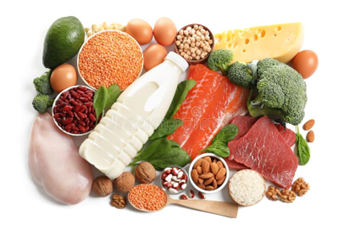
Let’s revisit protein and what it means to consume them.
What foods do I eat?!
PROTEIN
Foods to Consume
According to the International Society of Sports Nutrition (ISSN), a person is advised to consume 1.4 to 2.0 grams (g) of protein per kilogram (kg) of body weight per day. If you are training at a high intensity, consuming at the higher end of the range will greatly benefit you.
ex| a 150 pound (lbs) person would equal ~68 kg; which would mean that person should consume 95.2 to 136 g of protein.
If you wish to calculate your weight into kilograms, divide the pounds by 2.205; then multiply by a number by 1.4 and 2 to get your range.
| Foods | Grams (g) of Protein | How it’s cooked/Quantity | Other Benefits |
| Almonds | 29 g | A cup of dry roasted | Fiber, vitamin B |
| Chicken Breast | 35.5 g | Without skin & at 120g of chicken | Low in fat proteins |
| Cottage Cheese | 14 g | Per half-cup | Rich in calcium and contains Casein. |
| Edamame (beans) | 6 g | Per half-cup | Quick snack option |
| Eggs | 6.28 g | Boiled/poached | Protein & Vitamin B |
| Greek Yogurt | 12-18 g | For 5 oz | Great base to add other ingredients to |
| Jerky | 10-15 g | Per oz | Easily transportable |
| Lean Meat | 23 g | Per 4 oz | Selenium, zinc, & iron |
| Milk | 8 g 13 g | Skimmed milk per 8oz High protein per 8oz | Calcium |
| Mozzarella Cheese | 31 g | A cup | *Limit this intake due to its saturated fats |
| Quinoa | 9.1-15.7 g | Per 100 g (depends on where it’s manufactured) | Fiber, high range in vitamins & minerals, antioxidants |
| Salmon | 58.5 g | at 227g weight of Salmon | Omega-3 fatty acid |
| Soy Protein Powder | 25 g | Per scoop | plant-based |
| Tuna | 7 g | Per ounce (oz) | Omega-3 fatty acid |
| Turkey | 37.23 g 27 g | One cup of chopped Turkey leg | Low in fat proteins |
| Whey Protein Powder | 50 g | Per 3 scoops | Great for on the go in shakes |
Other mentions: Brown Rice, Tofu, seeds, Chickpeas, Seafood, peanuts, walnuts, buckwheat, pork, lentils, beans, soy milk, High protein cereals.
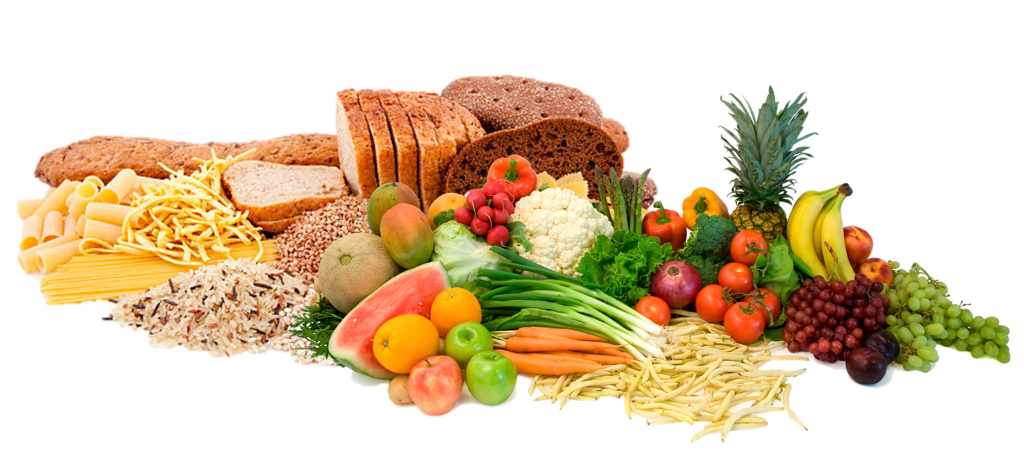
Carbs, CaRbS, CARBS…
Carbohydrates Foods to Consume
Carbohydrates (carbs) are the main source of your body’s energy. The source of carbs come from plant and dairy food which create sugars, starches and fiber. The ISSN suggests consuming carbohydrates at 45-65% of your daily intake of calories. Your level of intake depends greatly on your body type/size, activity level and blood sugar control.

Carbohydrates break down into glucose which is the fuel for our brain and muscles. However, depending on the form of the carbs, will depend on how your body breaks down and holds on to the carbs.
Some foods are processed to last longer but it strips the health benefits. Try your best to stay away from these foods.
Only up to 50g of added sugars should be in your daily intake. Check those sodas & Starbucks nutrition labels!
There are two main types of categories of carbs which are based on the number of sugar units and how these sugar units are connected chemically. Then they are broken up into subtypes, however to keep this simple, we are sticking to the Complex & Simple Carbs breakdown.
Main Types of Carbohydrates
| Type | Facts | Daily Intake | Foods |
| COMPLEX CARB Starch/Dietary Fiber | Complex carb refers to many sugars strung together. – The body does NOT digest this type easily. – Promotes regular bowel movements. Lowers blood sugar & cholesterol | * 275 g total for any type of carbs | fruits, vegetables, nuts, seeds, beans & whole grains |
| SIMPLE CARBS (Total Sugars, Sugar Alcohol) | Simple Carbs is the most basic form – The body easily absorbs and digests this type. – This type of sugar includes added sugars but also occurs in other foods naturally. – The body does NOT fully absorb – This is a reduced calorie sweetener (Sugar Alcohol, found in diet drinks) | * 275 g total for any type of carbs | Total Sugars: Dairy, baked goods (breads), desserts Sugar Alcohol: Chewing gum, baked goods, diet drinks |
Calorie
Cal•o•rie (noun)
(Oxford English Dictionary)
a unit of energy, often used to express the nutritional value of foods, equivalent to the heat energy needed to raise the temperature of 1 kilogram of water by 1 °C, and equal to one thousand small calories; a kilocalorie.
Start learning what your food intake is by glancing at the nutrition label. You may not understand all of it, but you will with time. The US Department of Agriculture has an amazing list of all the nutrition facts of each food. If you are unsure about what the contents are that you are eating, hop on over to their website: https://fdc.nal.usda.gov/index.html.
Here is a compact list (table 3.2) of foods to eat and their amount of carbs, the type of carbs and their other benefits:
| Foods | Grams (g) of Carbs | Type/Quantity/Weight | Type of Carb | A Few Other Benefits |
| Milk | 12 g | 1 cup of either 1%, 2%, or whole | Simple | Vitamin D, Vitamin A, Calcium, Potassium |
| Breads | 15 g 13 g 48 g 37 g | White (1 slice; 30 g) Wheat (1 slice;24 g) Bagel (whole; 98 g) French (1 slice; 59 g) | Simple | Vitamin B1, B3, Fiber |
| Pastas | 14 g 43 g 33 g | Fresh; cooked (2oz;57 g) Spaghetti; cooked (1 cup; 140 g) Ravioli with cheese (1 cup; 242 g) | Complex | Iron, magnesium |
| Beans | 8 g 8 g 55 g 68 g | Pinto; raw (1 tbsp; 12g) Chickpeas (1 tbsp; 12.5g) Baked beans (1 cup; 253 g) Refried beans (1 can; 443 g) | Complex | Iron, Vitamin B6. Magnesium |
| Bananas | 27 g | 1 medium (7” to 7-⅞” long; 118g) | Complex | Potassium, Vitamin C, Vitamin B6, Magnesium |
| Potatoes | 26 g | 1 medium (5.2 oz) with skin | Complex | Potassium, Calcium, Vitamin C, Vitamin B, Iron |
| Rice | 45 g 45 g 148 g | White rice; cooked (1 cup; 158 g) Brown rice; cooked (1 cup; 195 g) White rice; raw (1 cup; 185 g) | Complex | Vitamin B6, Magnesium, Iron, Calcium |
| Cereals | 27 g 55 g | Oatmeal; cooked (1 cup; 234 g) Breakfast (1 cup; 81 g) | Simple | Iron, Vitamin B6, Magnesium, Calcium |
WATER

This little molecule combo of two part hydrogen and one part oxygen (H2O), is one powerful compound. It makes up a vast percentage of our planet, the vegetation around us and our bodies.

There are many “rules of thumbs” on how much water you should be drinking, but the most common rule is drinking around ½ oz to 1 oz of water, per pound of a person’s weight, per day, according to Trent Nessler, PT, DPT, MPT.
ex| a 150 lbs person should drink around 75 to 150 oz of water per day.
Lets list out the valuable reasons why water is our MVP when it comes to our personal health:
- First building material for our cells
- Regulates body temperature
- Flushes out our system of toxins and waste
- Shock absorber for your brain and spinal cord
- Assists in lubricating the joints
- Transports the proteins & carbs through our bloodstream
So drink up this liquid gold in your favorite water bottle! Don’t have one? Here is a link to my newest addition to my collect: https://amzn.to/3STOaYx (affiliated link).
Water,
Earth,
Fire,
Air,
Vitamins & Minerals
Any Avatar: The Last Airbender fans?
VITAMINS & MINERALS
Table 5.1 & table 5.2 is a guide to what vitamins & minerals you need to achieve your muscle strength goals along with the benefits and what foods they can be mainly found in.
Vitamin
vi•ta•min (noun)
any of a group of organic compounds which are essential for normal growth and nutrition and are required in small quantities in the diet because they cannot be synthesized by the body.
(Oxford English Dictionary)
| Vitamin | What it Does | Where it’s Mainly Found |
| Vitamin A | Healthy vision, boost immune system | Carrot, green vegetables |
| Vitamin B* | Produces energy, enhances the body functions effectively, increases muscle mass, DNA replication | Animal and dairy products |
| Vitamin C | Anti-oxidant, formation of Iron | Citrus fruits, Berries, Tomato |
| Vitamin D | Bone growth | Fish, Egg yolk, Cheese |
| Vitamin E | Anti-oxidant, boost immune system | Almond, Peanuts, Soy beans |
| Vitamin K | Blood coagulation | Green leafy Vegetables |
*There are eight B vitamins that are identified both by number and by name. In numerical order they are: B1 (thiamin), B2 (riboflavin), B3 (niacin), B5 (pantothenic acid), B6 (pyridoxine), B7 (biotin), B9 (folate) and B12 (cobalamin).
Mineral
min•er•al (noun)
(Oxford English Dictionary)
a solid inorganic substance of natural occurrence.
| Mineral | What it Does | Where it’s Mainly Found |
| Calcium | For healthy bones, supports muscle contraction | Dairy (milks, cheeses, yogurts), Winter Squash, Edamame, Almonds |
| Phosphorus | For healthy and strong bones | Dairy, Red Meat, Poultry, Seafood, & nuts |
| Magnesium | Supports muscle & nerve function and energy production | Whole grains. dark-green leafy vegetables, Beans, nuts |
| Sodium | Type of electrolyte. Conduct nerve impulses, contract and relax muscles, and maintain a proper balance of water & minerals | Breads, cold cuts & cured meats, fruits (Apples, Avocados, Mangos, Pineapples), poultry |
| Potassium | Type of electrolyte. Maintains normal levels of fluid inside our cells. Also helps muscles to contract and supports normal blood pressure. | Dried fruits (raisins), Beans, Potatoes, Winter Squash, Spinach, fruits (Avocado, Bananas) |
| Chloride | Type of electrolyte. Helps to keep a proper balance of body fluids and maintain the body’s acid-base balance. | Table or Sea Salt. Vegetables (Seaweed, Tomatoes, Lettuce) |
| Sulfur | Builds & fixes your DNA. Protects cells from damage. Contributes to the health of your skin, tendons, and ligaments | Poultry, Beef, Eggs, Nuts, Oats, Vegetables, Whole Grains |
CONCLUSION

We have just skimmed the surface in the nutritional world. This article provides a broad snapshot that will assist in your navigation to achieve your fitness goals and minimize your potential frustration.
Before diving deeper into this topic, first start journaling what you are naturally eating now and jot down the nutritional facts of these foods. You can be simple and just use your notes section on your phone or use a journal like this one (affiliated link) to help keep you organized.
If you need to make a change, start small. Substitute that soda for water or even a tea. And don’t forget to celebrate the small wins that you are accomplishing.
Let’s Accomplish Goals!
Sources
Advances in Nutrition. (Nov 2014) Carbohydrates. Article 5; issue 6. Retrieved from doi: 10.3945/an.114.006163
Body Hub (May 2022) 12 best foods for muscle building and strength. Retrieved from: http://youtu.be/2Ni4Q7NOMkM
Brazier, Yvette (Dec 2020) What you need to know about carbs. Retrieved from: https://www.medicalnewstoday.com/articles/161547
Harvard, T.H. Chan (2022) The Nutrition Source. Retrieved from: https://www.hsph.harvard.edu/nutritionsource/
Medline Plus (2022) National Library of Medicine. Amino Acids. Retrieved from: http://medlineplus.gov/ency/article/002222.htm
National Kidney Foundation (2022) Phosphorus and your diet. Retrieved from: https://www.kidney.org/atoz/content/phosphorus
Oxford English Dictionary (2022) Calorie Definition. Retrieved from: https://www.oed.com/
Panvini, R.S. (2003) Vanderbilt University. Physics lecture notes on atoms. Retrieved from: https://www.vanderbilt.edu/
Richards, Louisa (March 2021) 30 muscle-building foods to fuel your goals. Retrieved from: http://www.medicalnewstoday.com/articles/muscle-building-foods# importance-of-nutrition
Shaw, Gina (February 2022) Nourish by WebMD. Water and Your Diet: Staying Slim and Regular With H2O. Retrieved from: https://www.webmd.com/diet/features
U.S. Department of Agriculture (2022) Food data central. Retrieved from: https://fdc.nal.usda.gov/index.html
Water Science School (May 2019) United States Geological Survey. The water in you: Water and the human body. Retrieved from: https://www.usgs.gov/special- topics/water-science-school/science/water-you-water-and-human-body
 OT Aerialist
Leave a comment